
Bank vs loose density of gravel, sand and soil
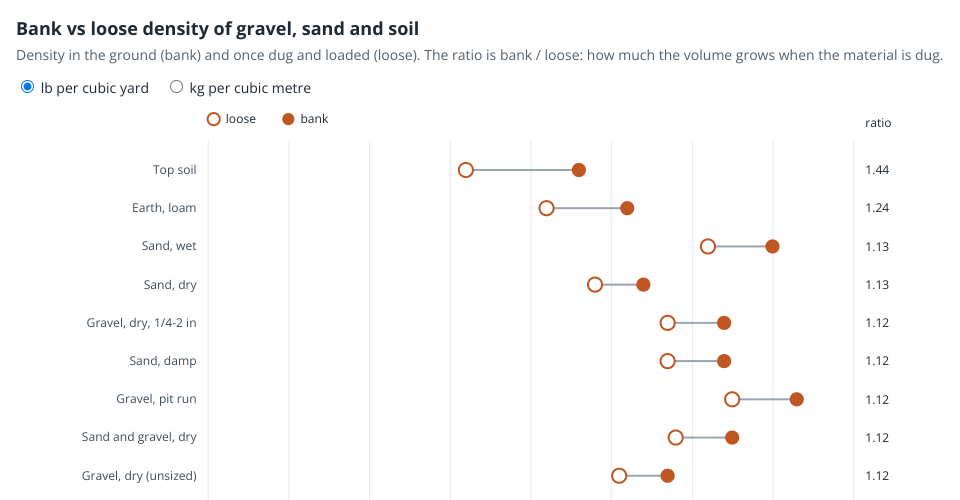
Interactive chart of how much a cubic yard of gravel, sand or soil weighs in the ground (bank, undisturbed) and once dug and loaded (loose). Published by TakeoffMetric.
What the chart shows
- The 9 materials of the dataset for which Caterpillar's reference table gives both a loose and a bank density
- One row per material: the loose density (open dot) and the bank density (filled dot), in lb per cubic yard or kg per cubic metre (toggle)
- The bank-to-loose ratio at the right of each row; lowest 1.12: Gravel, dry (unsized); highest 1.44: Top soil
The same mass takes more room once it is dug. Example with dry sand: 10 cu yd measured in the bank weigh 27,000 lb (10 x 2,700); loose at 2,400 lb/cu yd, that mass fills 11.25 cu yd in the truck. Which density a supplier or a haul ticket uses changes the quantity to order.
Data
data.csv is generated from constants.csv of the dataset
US Construction Estimating Constants
(commit 4862d1a, rows AGG-001, AGG-002, AGG-004, AGG-005, AGG-006, AGG-007, AGG-009, AGG-010, AGG-012, AGG-013, AGG-014, AGG-015, AGG-016, AGG-017, AGG-018, AGG-019, AGG-020, AGG-021), CC BY 4.0 for the compilation.
The lb per cubic yard values are Caterpillar's, read in its
earthwork volumes reference tables; the kg per cubic metre
values are the dataset's value_si column, converted from lb/yd3 with the
exact NIST factors and rounded to 4 significant digits. Columns: material,
loose_id, loose_condition, loose_lb_yd3, loose_kg_m3, bank_id,
bank_lb_yd3, bank_kg_m3, bank_to_loose (bank / loose, computed).
The same dataset is on DataHub.
In the dataset, the used_by_tool_url column of these rows points to these
TakeoffMetric calculator pages:
- takeoffmetric.com/earthwork/gravel-calculator/
- takeoffmetric.com/earthwork/sand-calculator/
- takeoffmetric.com/earthwork/topsoil-calculator/
- takeoffmetric.com/masonry/paver-base-calculator/
How the calculators use them: methodology.
Densities change with moisture, gradation and compaction. Confirm with your supplier before ordering.
Built with D3 v7. Code: MIT.